

A custom full-length wall mirror may look attractive in product photos, yet show a completely different result after installation.
When customers stand in front of the mirror, their body may appear unusually wide, narrow, stretched, or slightly curved. Straight lines reflected in the mirror may also appear wavy instead of straight.
For consumers, this is frustrating. For hotel contractors, furniture importers, interior designers, and cross-border sellers, it can become a costly quality problem.
The obvious question is:
Why do some cheap custom full-length wall mirrors have distorted reflections?
In most cases, the problem is not caused by the mirror's size alone. Reflection distortion can be related to glass flatness, mirror thickness, silvering quality, backing structure, frame pressure, installation conditions, and manufacturing tolerances.
This means buyers should not judge a full-length mirror only by its appearance, frame design, or quotation.
A better purchasing question is:
Can the manufacturer consistently produce a large mirror with sufficiently uniform optical flatness and stable structural support?
For buyers looking for custom full-length mirrors, Tengte (zhangzhou) Crafts Co., Ltd. provides customized mirror manufacturing solutions for bathroom, bedroom, dressing, hotel, commercial, and home furnishing applications through www.ttmirror.com.

1. What Does Distorted Reflection in a Full-Length Mirror Look Like?
Reflection distortion occurs when the mirror does not reproduce the reflected image with sufficient uniformity.
Typical visual symptoms include:
The body looks wider in one area than another
Vertical lines appear slightly curved
The head or shoulders appear stretched
Furniture behind the viewer looks uneven
Straight architectural lines appear wavy
The reflected image changes noticeably when viewed from different positions
For a small decorative mirror, minor optical irregularities may be less obvious.
For a custom full-length wall mirror, however, the much larger reflective area makes surface flatness more important.
A person standing several feet away can easily notice inconsistent reflections across the mirror.
This is why large-format mirror procurement requires more attention to manufacturing consistency than simply selecting a visually attractive frame.

2. Why Are Cheap Custom Full-Length Wall Mirrors More Likely to Show Distortion?
Low pricing itself does not automatically mean poor optical quality.
However, when a supplier significantly reduces manufacturing cost, some quality-related factors may also be reduced, such as:
Glass material specification
Glass thickness
Flatness consistency
Processing accuracy
Backing structure
Frame support
Quality inspection
Packaging protection
The final product may still look acceptable when viewed straight on in a product photograph.
The problem appears when the mirror is installed and used at full scale.
For procurement teams, this is why factory process control can matter more than the advertised mirror price.
3. Main Cause No. 1: Poor Glass Flatness
Glass is the foundation of mirror quality.
A mirror can have a highly reflective silver layer and still produce an unsatisfactory image if the glass substrate is not sufficiently flat.
When the glass surface contains subtle deformation, the reflected image can be visually displaced.
This may create:
Straight Object → Slightly Bent Reflection
or:
Human Body → Uneven Reflection
For a full-length wall mirror, the larger the visible surface, the more easily such irregularities may become noticeable.
Therefore, buyers should ask suppliers whether the glass specification is suitable for large-format mirror applications instead of simply asking for the cheapest available glass.
4. Main Cause No. 2: Inappropriate Mirror Thickness
Mirror thickness influences rigidity and overall structural behavior.
A thinner glass sheet may be lighter and less expensive, but large-format applications require careful consideration of:
Mirror dimensions
Mounting method
Support structure
Frame construction
Handling requirements
Installation environment
The appropriate thickness depends on the actual mirror dimensions and design.
It would be incorrect to claim that “thicker is always better.”
The correct approach is:
Mirror Size + Glass Specification + Frame Structure + Mounting Method
must be evaluated together.
For large custom mirrors, the factory should recommend a suitable construction rather than applying one thickness to every project.
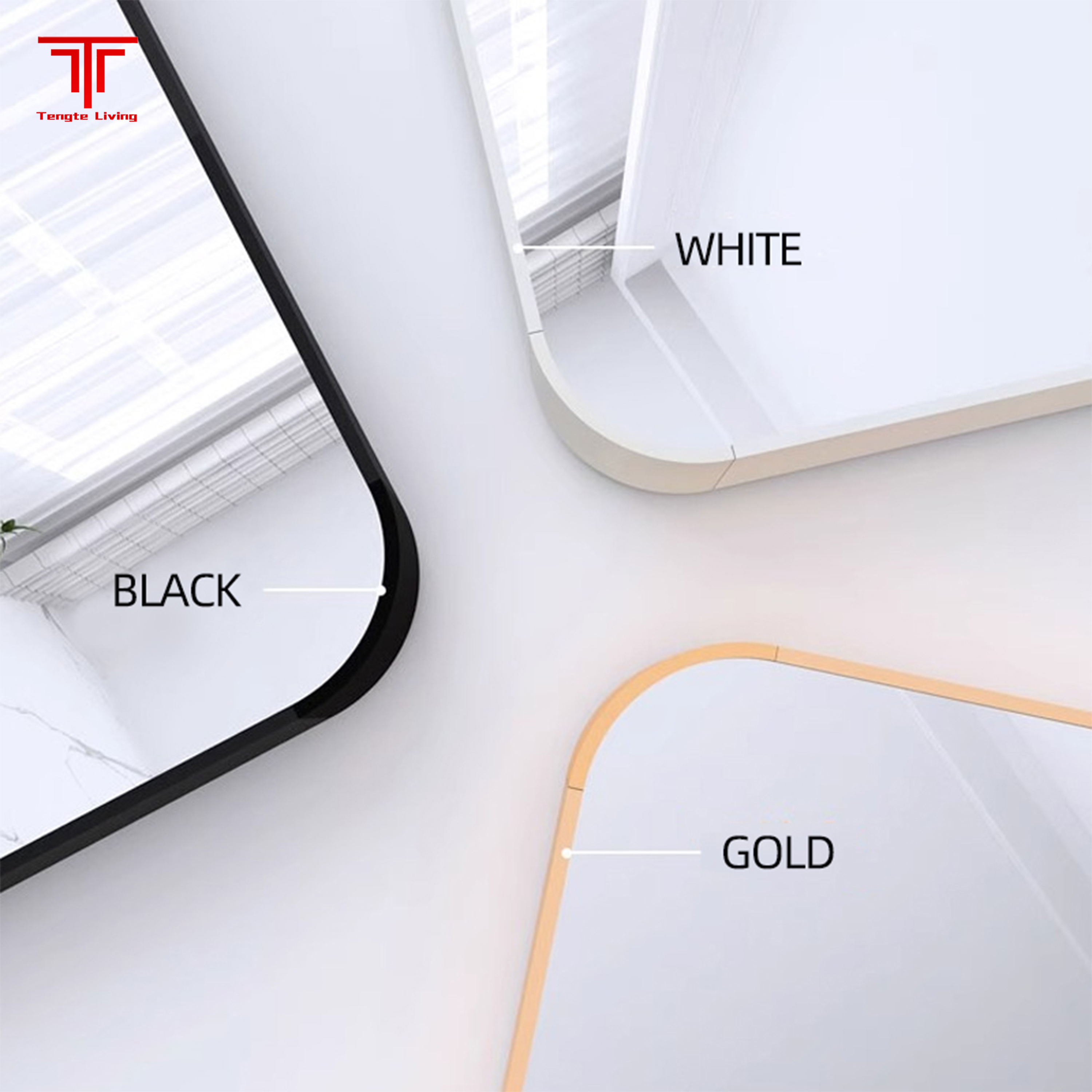
5. Main Cause No. 3: Improper Backing or Frame Pressure
Many buyers focus on the front surface while ignoring what happens behind the mirror.
A large mirror needs stable support.
If the frame or backing structure applies uneven pressure, it can influence the flatness of the mirror.
Potential causes include:
Uneven frame contact
Excessive fixing pressure
Improper backing support
Structural deformation during assembly
Incorrect mounting hardware
Uneven wall conditions
For a custom full-length wall mirror, the frame should support the glass without introducing unnecessary localized stress.
This is especially important for framed full-length mirrors used in hotels, apartments, bedrooms, dressing rooms, and retail environments.
6. Main Cause No. 4: Inconsistent Processing During Manufacturing
A custom-shaped or full-length mirror requires more than simply cutting a sheet of glass to size.
The production process can involve:
Glass Selection → Cutting → Edge Processing → Silvering → Back Coating → Assembly → Inspection → Packaging
Variations at different stages may affect the final product.
For example, inconsistent cutting or edge processing may create dimensional differences.
Improper assembly may introduce pressure.
Inadequate inspection may allow visually distorted units to pass into bulk shipments.
For buyers purchasing hundreds of mirrors, this is particularly important because the key issue is not whether the supplier can make one good sample.
It is whether the supplier can reproduce the approved quality throughout the entire production batch.
7. Main Cause No. 5: Large Mirror Packaging and Transportation Problems
A mirror can leave the factory in good condition and still arrive with problems if packaging is inadequate.
Full-length mirrors are vulnerable to:
Impact
Vibration
Compression
Improper stacking
Corner damage
Frame deformation
Mishandling during loading
For export orders, packaging therefore becomes part of quality control.
A poorly supported mirror may experience structural stress during transportation.
This is one reason buyers should evaluate:
Product Manufacturing + Export Packaging
as a single procurement system.
8. Why Product Photos Cannot Prove Reflection Quality
One of the common problems with online mirror sourcing is that photographs are not enough to evaluate optical performance.
A product photo may show:
Frame color
Mirror shape
Overall design
Packaging appearance
But it usually cannot reliably demonstrate the mirror's actual reflection quality.
A better sample evaluation method is to place the mirror in front of:
A straight architectural line
A vertical door frame
A window frame
A ruler or other straight reference
A standing person
The buyer can then check whether the reflected line remains visually straight from different viewing positions.
For commercial procurement, this simple visual evaluation can be more meaningful than product photography alone.
9. What Technical Parameters Should Buyers Check?
When purchasing a custom full-length wall mirror, buyers should request a technical specification that covers the complete construction.
| Parameter | What to Confirm |
|---|---|
| Mirror Type | Standard / custom full-length mirror |
| Glass Thickness | Project-specific specification |
| Glass Flatness | Applicable quality requirement |
| Overall Size | Exact finished dimensions |
| Shape | Rectangle / arch / customized |
| Edge Treatment | Grinding / polishing / other |
| Frame Material | Metal / wood / other |
| Frame Profile | Width, depth, structure |
| Backing | Back support or protective structure |
| Mounting | Wall-mounted / floor-standing |
| Reflection Quality | Visual inspection standard |
| Dimensional Tolerance | Agreed production tolerance |
| Packaging | Export protection specification |
| Sample | Pre-production approval |
| Final QC | Pre-shipment inspection |
This allows buyers to compare suppliers more objectively.
10. How Should Buyers Evaluate Reflection Quality?
There is no single universal number that can describe every mirror's optical quality for every application.
Instead, buyers should establish a practical inspection method.
Test 1: Straight-Line Reflection
Place the mirror opposite a straight vertical or horizontal reference.
Look for:
Wavy reflection
Bending
Discontinuous lines
Localized image displacement
Test 2: Full-Body Reflection
Stand several feet away from the mirror.
Check whether:
Head and shoulders appear proportional
Legs appear unusually wide or narrow
Body shape changes between different areas
Test 3: Different Viewing Angles
Move sideways while looking at the reflection.
A severe change in apparent shape can indicate inconsistent surface flatness or structural issues.
Test 4: Multiple Units
For bulk orders, inspect multiple pieces rather than approving only one sample.
The objective is to verify batch consistency.
11. Why Large Mirrors Require More Careful Tolerance Control
As mirror dimensions increase, the consequences of small manufacturing or structural deviations can become more noticeable.
Consider a mirror designed for a wardrobe wall.
If the mirror is not sufficiently stable:
Reflection quality may vary across the surface
The frame may not align correctly
Mounting points may require adjustment
The installation team may need additional correction work
For a single residential mirror, this may be inconvenient.
For 300 or 1,000 units in a hospitality project, the same issue can become a serious operational problem.
This is why large-format mirror procurement should emphasize repeatability, not just individual sample quality.
12. Application Scenario: Bedroom and Dressing Areas
Full-length wall mirrors are frequently used in:
Bedrooms
Dressing rooms
Walk-in closets
Wardrobe areas
Entryways
In these environments, reflection accuracy matters because users directly compare their appearance against the mirror.
A distorted reflection can affect the perceived quality of the whole product.
For furniture importers, this means mirror quality can influence the reputation of the surrounding furniture collection as well.
13. Application Scenario: Hotel Projects
Hotel operators often install many mirrors of the same design.
For example:
500 Rooms → 500 Full-Length Mirrors
The procurement challenge becomes consistency.
The buyer needs every unit to have:
Similar dimensions
Similar frame appearance
Similar reflection quality
Similar edge finish
Similar packaging
Similar installation requirements
A supplier capable of producing one good mirror is not necessarily capable of delivering the same performance across a large production batch.
For hotel projects, the more important supplier question is:
What quality-control system is used to reproduce the approved mirror specification across the complete order?
14. Application Scenario: Home Furnishing Importers and Cross-Border Sellers
For online sellers, distorted reflections can create a particularly damaging customer experience.
A customer may purchase a full-length mirror expecting an accurate reflection.
After installation, the mirror appears visually distorted.
The seller may then face:
Negative product reviews
Customer complaints
Refund requests
Replacement shipments
Increased after-sales workload
Additional logistics costs
This is why a low factory price should never be evaluated independently from product quality.
The actual commercial equation is closer to:
Purchase Cost + Freight + After-Sales Risk + Replacement Cost
15. What Are the Most Common Procurement Mistakes?
Mistake 1: Choosing the Lowest Quotation
The lowest price may reflect differences in glass, processing, frame construction, inspection, or packaging.
Mistake 2: Checking Only One Sample
A perfect sample does not automatically prove batch consistency.
Mistake 3: Ignoring Reflection Quality
Buyers sometimes inspect only frame color and dimensions.
For a full-length mirror, the reflection is the primary functional performance indicator.
Mistake 4: Not Confirming the Installation Structure
Uneven mounting pressure can affect the final appearance.
Mistake 5: Treating Packaging as a Logistics Detail
Large mirrors require packaging designed around their dimensions and structure.
Mistake 6: No Clear Inspection Standard
Without an agreed inspection method, supplier and buyer may have different interpretations of “good mirror quality.”
16. How Should Buyers Compare Different Mirror Suppliers?
A useful supplier comparison framework is:
| Evaluation Factor | Basic Supplier | Quality-Focused Manufacturer |
|---|---|---|
| Glass Specification | May be unclear | Clearly defined |
| Large-Format Experience | Limited / uncertain | Project-oriented |
| Drawing Support | May be limited | Available |
| Frame Customization | Standard options | OEM/ODM |
| Reflection Inspection | Not always defined | Controlled process |
| Batch QC | Unclear | Defined checkpoints |
| Sample Approval | Optional | Recommended |
| Export Packaging | Basic | Project-specific |
| Custom Dimensions | Limited | Supported |
| After-Sales Risk | Higher uncertainty | Better controlled |
The goal is not necessarily to choose the supplier with the highest price.
The goal is to choose the supplier with the best balance of product performance, repeatability, service, packaging, and total project cost.
17. How Does a Professional Factory Control Full-Length Mirror Quality?
For a custom mirror factory, quality control should begin before assembly.
Step 1: Material Review
Confirm the glass and frame materials against the approved specification.
Step 2: Dimensional Control
Verify the mirror dimensions and frame dimensions.
Step 3: Edge Processing
Inspect the edge for smoothness and consistency.
Step 4: Mirror Surface Inspection
Check visual defects and reflection quality.
Step 5: Frame Assembly
Confirm proper contact and alignment without unnecessary pressure on the glass.
Step 6: Final Appearance Inspection
Check the complete mirror from different viewing positions.
Step 7: Packaging Inspection
Ensure the mirror has adequate protection for transportation.
This multi-stage approach can help identify defects before the product reaches the buyer.
18. How Tengte (zhangzhou) Crafts Co., Ltd. Supports Custom Mirror Buyers
Tengte (zhangzhou) Crafts Co., Ltd. provides OEM/ODM mirror manufacturing for customers requiring customized dimensions, shapes, frames, and product configurations.
Through www.ttmirror.com, international buyers can source products including:
Full-length wall mirrors
Framed mirrors
Bathroom mirrors
Customized mirrors
Metal-framed mirrors
Large-format decorative mirrors
For projects requiring custom dimensions, the manufacturing workflow can be organized around:
Design Requirements → Technical Review → Sample Production → Buyer Approval → Mass Production → Quality Inspection → Export Packaging
This helps create a clearer connection between the buyer's original specification and the final production batch.
19. Why Sample Approval Should Be Part of the Procurement Process
For a custom mirror, the sample serves as more than a visual reference.
It can establish the expected standard for:
Size
Shape
Frame
Edge treatment
Reflection
Surface appearance
Assembly
Packaging
For bulk orders, buyers should retain the approved sample information and associated drawing or specification as a reference for mass production.
This provides a stronger basis for quality inspection and reduces misunderstandings.
20. A Practical Inspection Checklist Before Bulk Production
Before approving mass production, buyers can check:
Glass appears flat and visually consistent
Reflection is not obviously wavy or distorted
Body proportions appear natural
Straight reference lines remain visually straight
Overall dimensions are correct
Frame is aligned
Frame does not exert obvious uneven pressure
Edge finishing is consistent
Backing structure is intact
Mounting points are correctly positioned
Packaging provides adequate support
This simple checklist can help buyers identify optical and structural issues before committing to a large order.
21. Why Reflection Quality Is an Important Brand Issue
A bathroom or full-length mirror is highly visible to the end customer.
Unlike hidden furniture components, the mirror is directly used every day.
A distorted reflection can immediately create the perception that the product is cheap or poorly manufactured.
For a retailer or home furnishing brand, that perception can extend beyond the mirror itself to the entire product range.
Therefore, reflection quality is not just a technical specification. It is part of the customer's perception of product quality.
22. How to Reduce Risk When Sourcing Large Custom Mirrors
A lower-risk procurement strategy can follow seven steps:
1. Define the Mirror Size
Provide exact finished dimensions.
2. Define the Frame
Confirm material, profile, finish, and structural requirements.
3. Request a Sample
Evaluate the actual mirror rather than relying only on photos.
4. Check Reflection Quality
Use straight-line and full-body visual tests.
5. Approve the Specification
Confirm the sample, dimensions, and construction before mass production.
6. Monitor Batch Quality
Inspect multiple production units where practical.
7. Confirm Export Packaging
Make sure large mirrors receive appropriate transportation protection.
This approach is particularly useful for international buyers who cannot easily perform on-site inspections after production begins.
23. Conclusion: The Cheapest Mirror Is Not Always the Lowest-Cost Choice
A custom full-length wall mirror with distorted reflection can create much larger problems than its initial purchase price suggests.
For hotel contractors, interior design companies, furniture importers, bathroom brands, and cross-border sellers, the key factors to evaluate include:
Glass Flatness + Suitable Thickness + Stable Backing + Frame Construction + Processing Accuracy + Reflection Inspection + Export Packaging
A quality-focused supplier should be able to explain how these variables are controlled.
The most important question is not:
“How cheap can you make this mirror?”
It is:
“How consistently can you reproduce the approved mirror quality at my required size and quantity?”
For buyers who need customized full-length wall mirrors, Tengte (zhangzhou) Crafts Co., Ltd. supports OEM/ODM manufacturing through www.ttmirror.com, with customized mirror dimensions, frame options, sample development, production inspection, and export-oriented packaging.
Request a Custom Full-Length Mirror Sample
When requesting a quotation, buyers are encouraged to provide:
Finished mirror dimensions
Quantity
Frame material and finish
Mirror thickness requirement
Installation method
CAD drawing or reference image
Destination country
Packaging requirements
Target delivery date
With these details, Tengte (zhangzhou) Crafts Co., Ltd. can evaluate the product requirements and provide a more accurate manufacturing solution.
TTmirror — Customized Bathroom Mirrors, Full-Length Mirrors and Framed Mirror OEM/ODM Solutions for Global Buyers.
Website: www.ttmirror.com
